March 10, 2009, 10:19 pm Fortune Magazine just published a list of the world’s most admired companies. The ranking on the list was established by a few more than 4,000 executives, directors, and securities analysts. I do business with number 1 (Apple: all my computers since 1984) and number 50 (Samsung: LCD HDTV) and many of the in-between ones (Google, GE, Microsoft (grudgingly), WalMart, Costco, Honda, Starbucks, Intel, Sony, Best Buy, AT&T). Why do these companies have such a strong reputation among business leaders? (A related question is why they have such a good reputation with the consumers.)
Most important, according to the survey, is a strong, stable strategy. “Companies that change strategies must usually change organizational structures as well… It forces employees to focus inward rather than outward and becomes a giant sink of time and energy.”
The data show that the structure of an organization is far less important than its strategy. The most admired companies don’t share a common operating model. What they do share is a focus on identifying and developing talent.
As I was reflecting on this article, I wondered how the principles these admired companies followed applied to my church, if at all. After first being tempted to consider them apples and oranges, I realized that both an excellent company and an excellent church require excellent leadership that lays out a clear and compelling strategy. A mushy strategy, or bouncing from one strategy to another, keeps a church from being effective.
Furthermore, like successful companies, a church, must concentrate on identifying and developing talent. This is exactly what Ephesians 4:12-13 means, “prepare God’s people for works of service, so that the body of Christ may be built up until we all reach unity in the faith and in the knowledge of the Son of God and become mature, attaining to the whole measure of the fullness of Christ.”
How is your church doing?
March 9, 2009, 9:48 pm  The birthday girls, plus one  Cortnie
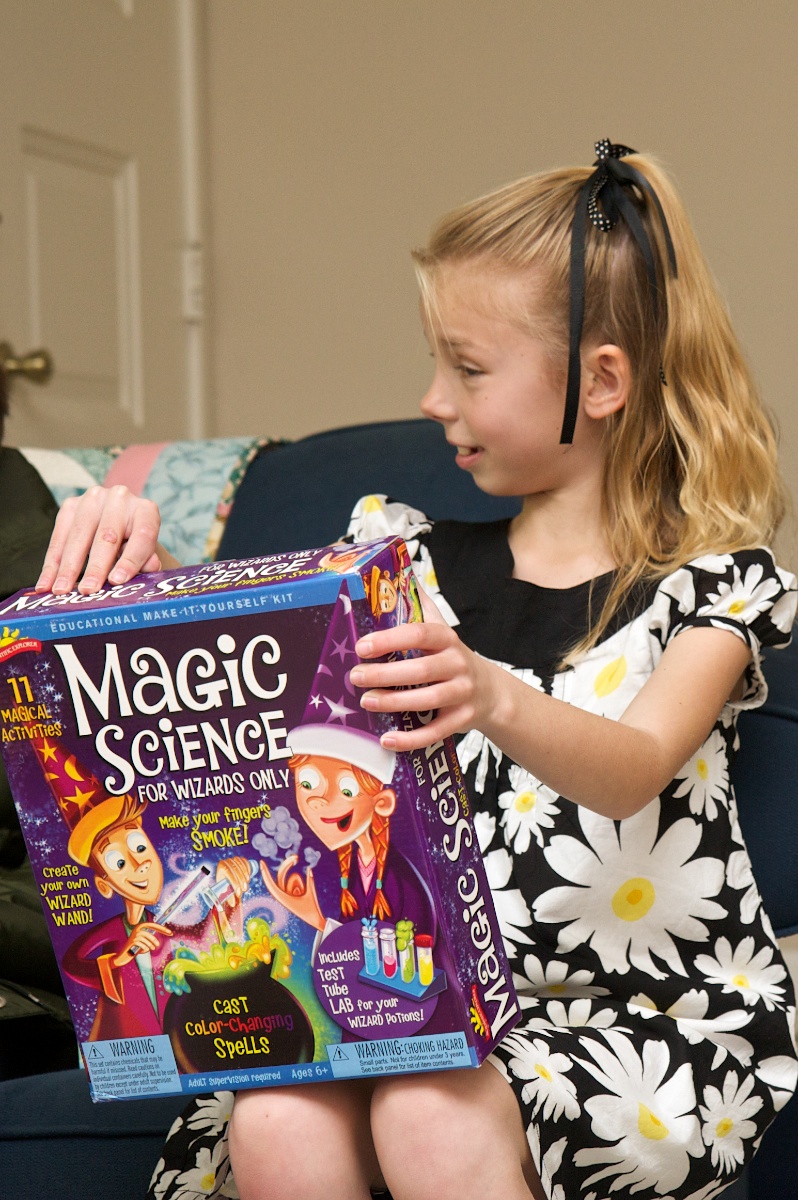
We celebrated with the birthday girls on Sunday. Of course, the little one thought it was great fun.
 Cortnie  Chase Several little experiements from the magic science kit were tried. I was interested in her reaction (pun intended) to the invisible ink one. We mixed up some citric acid in one test tube and some baking soda in another, then used a cotton swab to write on magic (litmus) paper. Her interest in that didn’t last long, but when I showed her what happens when I poured the two solutions together, she seemed fascinated by all the fizzing and bubbles. Perhaps science might have some magic for her in the future.
Links
—March 2009 birthdays photo gallery
March 6, 2009, 8:28 am Having experienced my wife’s diagnosis of breast cancer (doom and gloom scary), her mastectomy (pain for a few days), her chemotherapy (slow death, hoping it kills the cancer cells faster than it kills her), and her radiation treatments, I thought her life (and mine) might return to normal after a year or so of cancer-clear checks. Boy, was I wrong.
A cancer survivor’s life is never the same as it was pre-cancer, and not just because of the physical effects of surgery and chemo.
After every mammogram (and there are a lot more of them after a breast cancer diagnosis), there’s the anxious wait for the possible dreaded phone call requesting a return for some more detailed x-rays. And if that call comes, up pop all the fears—might she have to go through the whole treatment regimen again.
We feel like we’ve been through that in spades. About eight months ago she got that dreaded follow-up call to a routine mammogram, “Come back in for a more detailed digital mammogram.” That led to a conclusion there was a small spot, probably a calcification, in her breast, but a needle-core-biopsy should be done. The anxiety of the unknown returned. Was it cancer or benign?
Now, consider the difficulty of pushing a needle through a 1 mm spot in 3-D space guided only by 2-D pictures. The radiologist was unsuccessful, and recommended a surgical biopsy. A few weeks later, just before the surgery, another digital mammogram was done, and two radiologists agreed they couldn’t see anything to remove. So we were left in a quandary: was it a false positive that started the whole thing, or a false negative that there was nothing to remove. The final decision was to wait six months and do another mammogram.
A few days ago she had that six-month return visit for a mammogram, and began the subsequent anxious wondering if she would get a call to return. She did, and so we were on the emotional roller-coaster again, rushing down the hill of anxiety towards the pit of despair.
Thankfully, after several x-rays and a sonogram on the return visit, her very thorough radiologist recommended sitting tight and having another follow-up in six months. Emotions stabilized; life is good.
But in six months—maybe we’ll have to get back on the roller-coaster.
|
Consider this:“All of you, live in harmony with one another; be sympathetic, love as brothers, be compassionate and humble.” 1 Peter 3:8 |